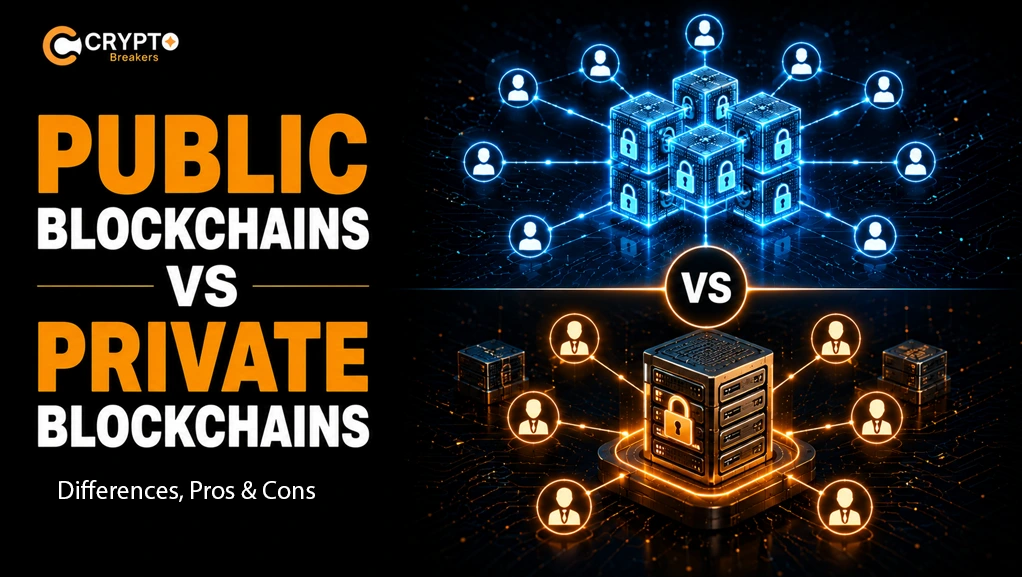
When I first learned about blockchain, I assumed every blockchain was public. Then I discovered private blockchains and wondered, “If blockchain is decentralized, why is it private?” That’s when I realized public and private blockchains are built for different purposes.
Here’s what many people don’t know:
Not every blockchain is public. Some are permissioned networks where only approved participants can access the ledger, validate transactions, and manage the network.
Understanding the difference between public and private blockchains helps you:
- Evaluate blockchain projects.
- Choose the right blockchain.
- Understand decentralization, privacy, and speed.
- Compare blockchain networks.
In this guide, you’ll learn the key differences between public and private blockchains, their characteristics, advantages, use cases, and how to choose the right one for your needs.
What Are Public Blockchains?
A public blockchain is a permissionless blockchain network that anyone can join, use, and help secure without needing approval from a central authority. Users can send transactions, deploy smart contracts, and verify data on the distributed ledger.
Unlike private blockchains, public blockchains are open to everyone. All confirmed transactions are recorded on a shared ledger that anyone can view and verify.
Key characteristics of a public blockchain include:
- Open access – Anyone with an internet connection can join the network.
- Decentralization – No single company or government controls the blockchain.
- Transparency – Transactions are publicly recorded and can be verified by anyone.
- Consensus mechanisms – Networks use Proof of Work (PoW) or Proof of Stake (PoS) to validate transactions and secure the blockchain.
- Native cryptocurrency – Coins such as Bitcoin (BTC) and Ether (ETH) reward miners or validators for maintaining the network.
- Censorship resistance – No central authority can easily block or alter confirmed transactions.
Some of the most well-known public blockchains include Bitcoin, Ethereum, Solana, Avalanche, and Cardano. These networks support cryptocurrencies, DeFi, NFTs, Web3 applications, tokenization, and decentralized governance.
Example: When you send Bitcoin or swap tokens on Ethereum, your transaction is verified by the public blockchain and permanently recorded on its distributed ledger.
What Are Private Blockchains?
A private blockchain is a permissioned blockchain network where a single organization controls who can join, access the distributed ledger, and validate transactions. Unlike a public blockchain, only authorized users can participate.
Private blockchains are designed for businesses and organizations that need greater privacy, faster transaction processing, and more control over their data.
Key characteristics of a private blockchain include:
- Restricted access – Only approved users can join and use the network.
- Centralized governance – A single organization manages the blockchain and its participants.
- Private transactions – Transaction data is shared only with authorized members.
- Higher performance – Fewer validator nodes enable faster transaction processing.
- No native cryptocurrency required – Most private blockchains operate without mining or token rewards.
Private blockchains are commonly used for supply chain management, healthcare, banking, digital identity, and other enterprise applications where sensitive information must remain private.
Private networks speed up finality by restricting the way blocks are added to a small set of pre-approved validator nodes.
Some of the most widely used private blockchain frameworks include Hyperledger Fabric, R3 Corda, Hyperledger Besu, and Quorum.
Example: A global retailer can use a private blockchain to track products across its supply chain while allowing only approved suppliers, manufacturers, and distributors to access the shared ledger.
Public vs Private Blockchain: What Is the Core Difference?
The biggest difference between a public blockchain and a private blockchain is who can access the network. A public blockchain is open to everyone, while a private blockchain only allows approved participants to join.
This difference affects how each blockchain handles governance, transparency, security, and transaction processing.
| Feature | Public Blockchain | Private Blockchain |
|---|---|---|
| Access | Open to anyone | Approved users only |
| Permission | Permissionless | Permissioned |
| Control | Community | Organization |
| Transparency | Public | Private |
| Speed | Moderate | Fast |
| Scalability | Lower | Higher |
| Consensus | PoW / PoS | PBFT / RAFT |
| Rewards | Native tokens | Usually none |
| Security | Decentralization | Access control |
| Governance | Community | Organization |
| Best For | Crypto & Web3 | Enterprise |
| Examples | Bitcoin, Ethereum | Hyperledger Fabric, R3 Corda |
Permissioned vs Permissionless Blockchains: What’s the Difference?
Many people use public and permissionless interchangeably, or assume private always means permissioned. While they’re closely related, they describe different aspects of a blockchain network.
- Public vs. Private describes who can view and access the blockchain.
- Permissioned vs. Permissionless describes who is allowed to submit transactions, validate blocks, or participate in maintaining the network.
In many cases, public blockchains are permissionless, and private blockchains are permissioned. However, these terms are not always interchangeable.
How They Compare
| Concept | Focus | Example |
|---|---|---|
| Public Blockchain | Who can access and view the blockchain | Bitcoin, Ethereum |
| Private Blockchain | Who owns and manages the blockchain | Hyperledger Fabric, R3 Corda |
| Permissionless | Anyone can participate without approval | Bitcoin, Ethereum |
| Permissioned | Only approved participants can validate or write data | Hyperledger Fabric, Quorum |
Key takeaway: Public and private describe the type of blockchain, while permissioned and permissionless describe how participation is controlled. This distinction makes it easier to compare different blockchain networks.
Why Do Companies Choose Private Blockchains?
While public blockchains are designed for open participation, many organizations prefer private blockchains because they provide greater privacy, control, and regulatory compliance. This makes them ideal for enterprise applications that handle sensitive business data.
Companies choose private blockchains for several reasons:
- Data privacy – Only authorized participants can access transaction data.
- Regulatory compliance – Supports KYC, AML, and industry regulations in sectors such as banking, healthcare, and finance.
- High performance – Fewer validator nodes allow transactions to be processed quickly with lower latency.
- Controlled access – Organizations decide who can read, write, and validate data.
- Lower operating costs – No mining or cryptocurrency rewards are required.
- Enterprise integration – Platforms such as Hyperledger Fabric and R3 Corda integrate with existing business systems and workflows.
Real-World Examples
| Organization | Platform | Primary Use |
|---|---|---|
| Walmart | IBM Food Trust | Supply chain tracking |
| JPMorgan | Onyx | Cross-border payments |
| Carrefour | IBM Food Trust | Food traceability |
| Central Banks | Various platforms | CBDC development |
| Ripple | Ripple Private Ledger | Enterprise payments |
Pros And Cons of Public Blockchains
Public blockchains provide decentralization, transparency, and open access, making them ideal for cryptocurrencies and decentralized applications. However, these benefits also come with certain limitations.
Pros of Public Blockchains
- Decentralized – No single organization controls the network.
- Transparent – Transactions are publicly recorded and verifiable.
- Secure – Protected by cryptography and distributed consensus.
- Censorship-resistant – Transactions cannot be easily blocked or altered.
- Open access – Anyone can participate without permission.
- Supports Web3 – Powers cryptocurrencies, DeFi, NFTs, and DAOs.
Cons of Public Blockchains
- Slower transactions – Consensus across many nodes can reduce processing speed.
- Scalability challenges – High network activity may cause congestion.
- Higher transaction fees – Fees can increase during peak demand.
- Limited privacy – Transactions are public and can be traced.
- Energy-intensive – Proof of Work (PoW) networks require significant computing power.
- Slower governance – Community-driven decisions often take longer to implement.
Pros and Cons of Private Blockchains
Private blockchains offer high performance, privacy, and greater control, making them suitable for enterprise applications. However, they achieve these benefits by reducing decentralization and transparency.
Pros of Private Blockchains
- Fast transactions – Fewer validator nodes enable quicker processing and finality.
- Private data – Only authorized participants can access transaction details.
- Regulatory compliance – Supports KYC, AML, and industry-specific regulations.
- Controlled access – Organizations manage who can read, write, and validate data.
- Lower operating costs – No mining or public cryptocurrency rewards are required.
- Customizable – Rules and permissions can be tailored to business needs.
Cons of Private Blockchains
- Less decentralized – A single organization or consortium controls the network.
- Limited transparency – Transaction data is not publicly accessible.
- Trust required – Participants must trust the organization managing the blockchain.
- Smaller validator network – Fewer validators can reduce network resilience.
- Less open innovation – Development is typically restricted to approved participants.
- Not ideal for public applications – Best suited for enterprise use rather than open ecosystems like DeFi or Web3.
Public vs Private Blockchain: Common Use Cases
Public and private blockchains are designed for different purposes. Public blockchains are best for open, decentralized applications, while private blockchains are better suited for businesses that need privacy, control, and regulatory compliance.
| Public Blockchain | Private Blockchain |
|---|---|
| Cryptocurrencies – Bitcoin, Ethereum, stablecoins | Supply chain – Product tracking and traceability |
| DeFi – Lending, borrowing, and decentralized exchanges | Banking – Payments, settlements, and trade finance |
| NFTs – Digital art, collectibles, and gaming assets | Healthcare – Secure patient record sharing |
| Tokenization – Real-world assets and securities | Digital identity – Identity verification and access management |
| DAOs – Community governance and voting | Government – Land records and public services |
| Web3 applications – Decentralized apps (dApps) | Insurance – Claims processing and fraud prevention |
| Cross-border payments – Peer-to-peer global transfers | Corporate auditing – Secure internal record management |
| Public blockchain projects | CBDC development – Permissioned digital currency networks |
Are There Other Types of Blockchains?
Yes. Besides public and private blockchains, there are consortium and hybrid blockchains. These models combine features of both and are designed for specific business and enterprise use cases.
Consortium Blockchain
A consortium blockchain is a permissioned blockchain managed by multiple organizations instead of a single company. Each member helps validate transactions and govern the network.
Common uses: Banking, supply chain management, and trade finance.
Example: Enterprise Ethereum Alliance (EEA) and other industry consortiums.
Hybrid Blockchain
A hybrid blockchain combines public and private blockchain features. Sensitive data remains private, while selected information can be shared on a public blockchain for transparency and verification.
Common uses: Government services, healthcare, digital identity, and enterprise applications.
Example: XDC Network (XinFin).
People Also Ask About public and Private blockchain
Is Bitcoin a Public Blockchain?
Yes. Bitcoin is a public, permissionless blockchain. Anyone can send transactions, run a node, or participate in mining without needing approval.
Is Ethereum Public or Private?
Ethereum is a public blockchain. However, organizations can build permissioned networks using Ethereum-based technologies such as Hyperledger Besu for private enterprise applications.
Can a Private Blockchain Become Public?
Yes, but it requires major changes to the network’s governance, consensus mechanism, and permission model. In practice, private and public blockchains are built for different purposes, so this is uncommon.
Why Are Private Blockchains Faster?
Private blockchains process transactions faster because they use a small number of trusted validator nodes. This allows them to reach consensus more quickly than public blockchains.
Which Blockchain Is More Scalable?
Private blockchains are generally more scalable because they operate with fewer participants and controlled access. Public blockchains often rely on Layer 2 solutions to improve scalability while maintaining decentralization.
Do Private Blockchains Use Mining?
No. Private blockchains do not use mining. They rely on consensus mechanisms such as PBFT or RAFT, where trusted validators confirm transactions.
Can Governments Use Public Blockchains?
Yes. Governments can use public blockchains for applications such as transparency initiatives and public record verification. However, many CBDC projects are built on private or hybrid blockchains to maintain greater control and privacy.
Can Public and Private Blockchains Work Together?
Yes. Organizations can connect public and private blockchains using interoperability protocols or cross-chain bridges, allowing data or assets to move securely between networks.
Is a Private Blockchain Really a Blockchain?
Yes. A private blockchain uses distributed ledger technology (DLT), cryptography, and consensus mechanisms like a public blockchain. The main difference is that access and governance are controlled by approved participants rather than being open to everyone.
My Take: Choosing the Right Blockchain Depends on the Use Case
After comparing both models, I’ve realized that public and private blockchains aren’t competitors; they’re built for different purposes.
Public blockchains prioritize decentralization, transparency, and open participation, while private blockchains focus on privacy, performance, and organizational control.
In my opinion, neither model is inherently better. The right choice depends on what you’re trying to achieve. If you’re building Web3 applications, using cryptocurrencies, or participating in DeFi, a public blockchain makes the most sense.
For businesses that need secure data sharing and regulatory compliance, a private blockchain is often the better fit.